


The Echo Panel.
Built to absorb.
Four blast-resistant concrete panel designs. Built first for explosive blast, with structural resistance to storm-scale wind. Service ratings from 20 psi up to 100+ psi of peak blast overpressure, with Echo Cast, our heaviest-duty panel.
Echo Foam is UL Level 10 certified and withstood 47 psi blast pressure in an open-air explosive test.
Overview
Four Echo panels. One product family.
Each design is built around a different core, validated under its own test program. Pick the rating that matches the threat.
Echo Series
Echo Foam
Foam-core sandwich panel
UL Level 10 ballistic rating plus 47 psi blast validation.
UL-10
47 psi · 5 lb C-4
Echo Series
Echo Lite
Thin-Wall Composite
Thin-shell composite that snaps into place. Field-replaceable, panel by panel.
20 psi
Modular interlock
Echo Series
Echo Arch
Composite arch
Custom hollow composite arch derived from a proven bridge beam, proven in a shock tube that reproduces a blast pressure wave.
40 psi
Shock-tube tested
Echo Series
Echo Cast
Cast panel
Heaviest-duty cast panel. Rated above 100 psi against live TNT.
100+ psi
75 lb TNT at 3 ft
By the Numbers
Engineered across the threat band.
Four
Panel Designs
Echo Foam, Echo Lite, Echo Arch, and Echo Cast. One product family, four cores, tuned for the threat.
100+ PSI
Heaviest-Duty Rating
Echo Cast validated above 100 psi against 75 lb TNT at 3 ft. The other three designs run from 20 to 47 psi.
Up to 80%
Concrete Reduction
Three of the four designs skip coarse aggregate and pour with a high-strength 6,000 psi mortar. Panels weigh less and go up faster on site.
1–8 psf
Shipping Weight
Lightweight at delivery, measured in pounds per square foot (psf). Precast and cast-in-place finished weights run 20–40 psf.
Threat Context
Why pressure ratings matter.
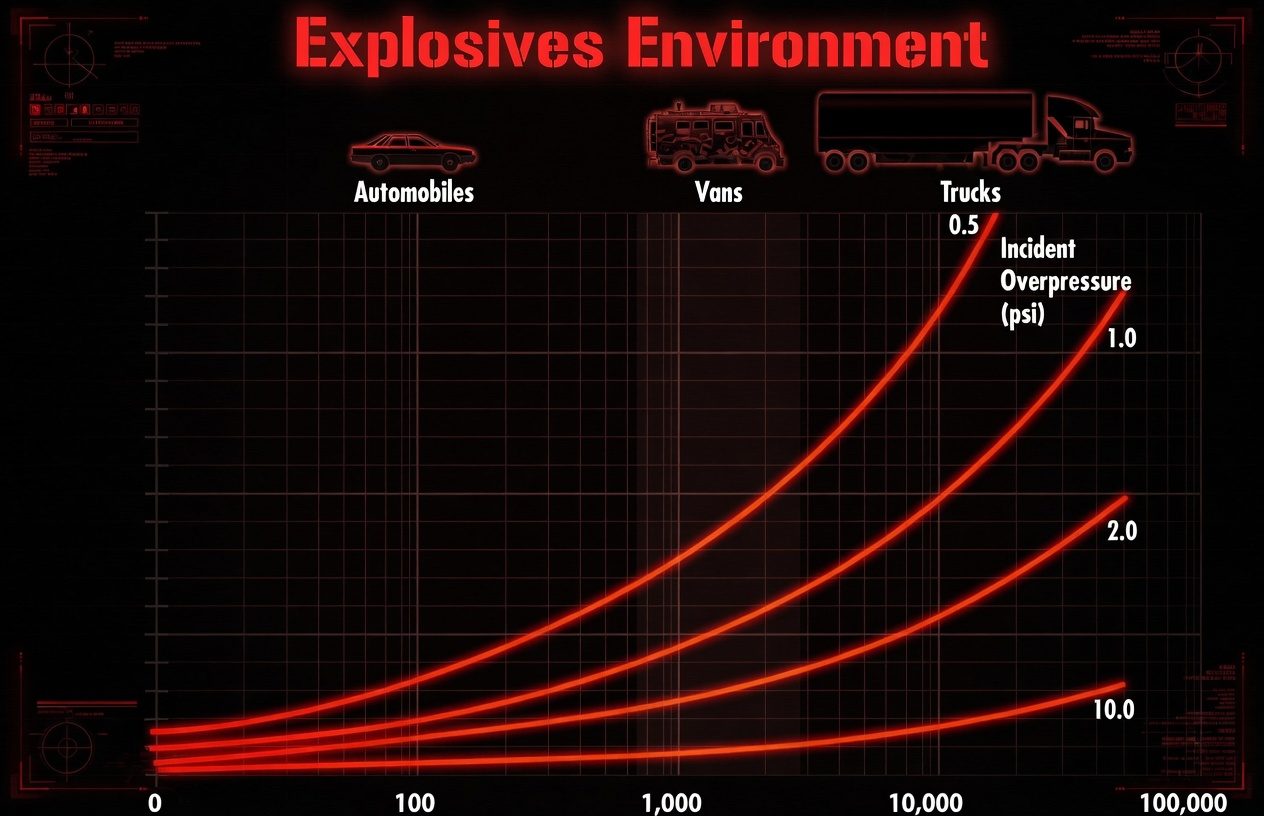
Vehicle-borne explosive threats range from passenger automobiles to box vans to tractor-trailers, with payloads spanning two orders of magnitude in net explosive weight. The incident overpressure a structure experiences depends on charge size and standoff distance.
At a given standoff, a 1 psi pulse begins to break windows and shed glazing, 2 psi begins to threaten unreinforced structures, and 10 psi pressures structural collapse in most conventional buildings. The four Echo panels span this band, with Echo Cast rated above 100 psi.
Reference: FEMA E155 Unit VI: Site and Urban Design for Security.
Specify the Echo Panel for your next project.
Project briefs, pressure specifications, and timeline reviews are handled directly with engineering.